
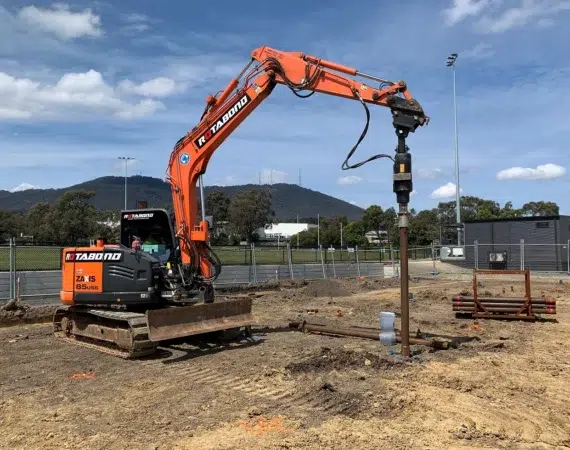
In June 2025, Rotabond completed the foundation works for a 280-metre coastal boardwalk. The site presented significant geotechnical and environmental challenges, including loose marine sands, a clay transition layer, and restricted working hours due to tidal cycles.
Through the application of torque-calibrated screw pile installation, the project achieved:
- 40% reduction in installation time (14 days instead of 23)
- 12% higher average pile capacity than initial design expectations
- Reduced environmental disturbance in a sensitive dune ecosystem
This case study details the site conditions, engineering methodology, technical data, quality assurance processes, and the broader industry implications of torque-calibrated piling in coastal applications.
Site & Geotechnical Context
The project site was located along a high-energy coastline with established dune vegetation. Protection of the dune system was a contractual and environmental requirement under the NSW Coastal Management Act 2016.
A geotechnical investigation was undertaken in accordance with AS 1726:2017 – Geotechnical Site Investigations. Borehole data indicated:
- 0–2.4 m: Loose fine marine sand (SPT N-value: 5–8)
- 2.4–3.8 m: Medium dense sand with shell fragments (SPT N-value: 12–15)
- 3.8–5.0 m: Very stiff clay (SPT N-value: >30)
Seasonal high tides impacted the working zone between 07:30 and 13:00 daily, meaning all piling operations had to be completed within this window to avoid flooding and equipment bogging.
Engineering
- Variable Soil Conditions: Rapid transition from loose sand to stiff clay made achieving uniform capacity difficult without real-time torque feedback.
- Corrosion Risk: Marine environment classified as R4 (very severe) under AS 2159:2009 – Piling Design and Installation, requiring enhanced coating systems.
- Restricted Access: Heavy tracked machinery was prohibited; installation had to be completed with a low-impact crawler carrier.
- Environmental Controls: No disturbance to dune root systems and minimal surface compaction allowed.
Methodology
Torque Calibration
Torque-capacity correlation was determined pre-site using the modified Hoyt & Clemence method and verified against historical site data. This involved:
- Calibrating the hydraulic drive head with a certified load cell.
- Establishing target torque thresholds:
- Sand layer: 9.5–10.5 kNm
- Clay layer: 16.0–18.0 kNm
Installation
- Positioning – GPS layout to ±10 mm accuracy to minimise rework.
- Advance in Sand – Low torque applied to avoid over-disturbance.
- Transition to Clay – Gradual torque ramp-up to penetrate without pile head deflection.
- Final Embedment – Achieve design torque at target depth of 4.5 m.
Quality Assurance
- Inspection and Test Plans (ITPs): All works documented and signed off daily.
- AS 2159 Compliance: Minimum 50-year design life achieved through hot-dip galvanising (600 g/m²) and epoxy top-coat.
- Third-Party Verification: Independent engineer witness load tests on 10% of piles.
- Documentation: Calibration certificates, torque logs, and as-built GPS data archived for client records.
Measured Results
Metric | Historical Avg. | This Project |
|---|---|---|
Avg. Install Time per Pile | 14 min | 8.4 min |
Torque Variance in Variable Soils | ±22% | ±6% |
Post-Install Capacity (kN) | 85–95 | 100–105 |
Total Project Duration | 23 days | 14 days |
Machinery Operating Hours | 184 hrs | 128 hrs |
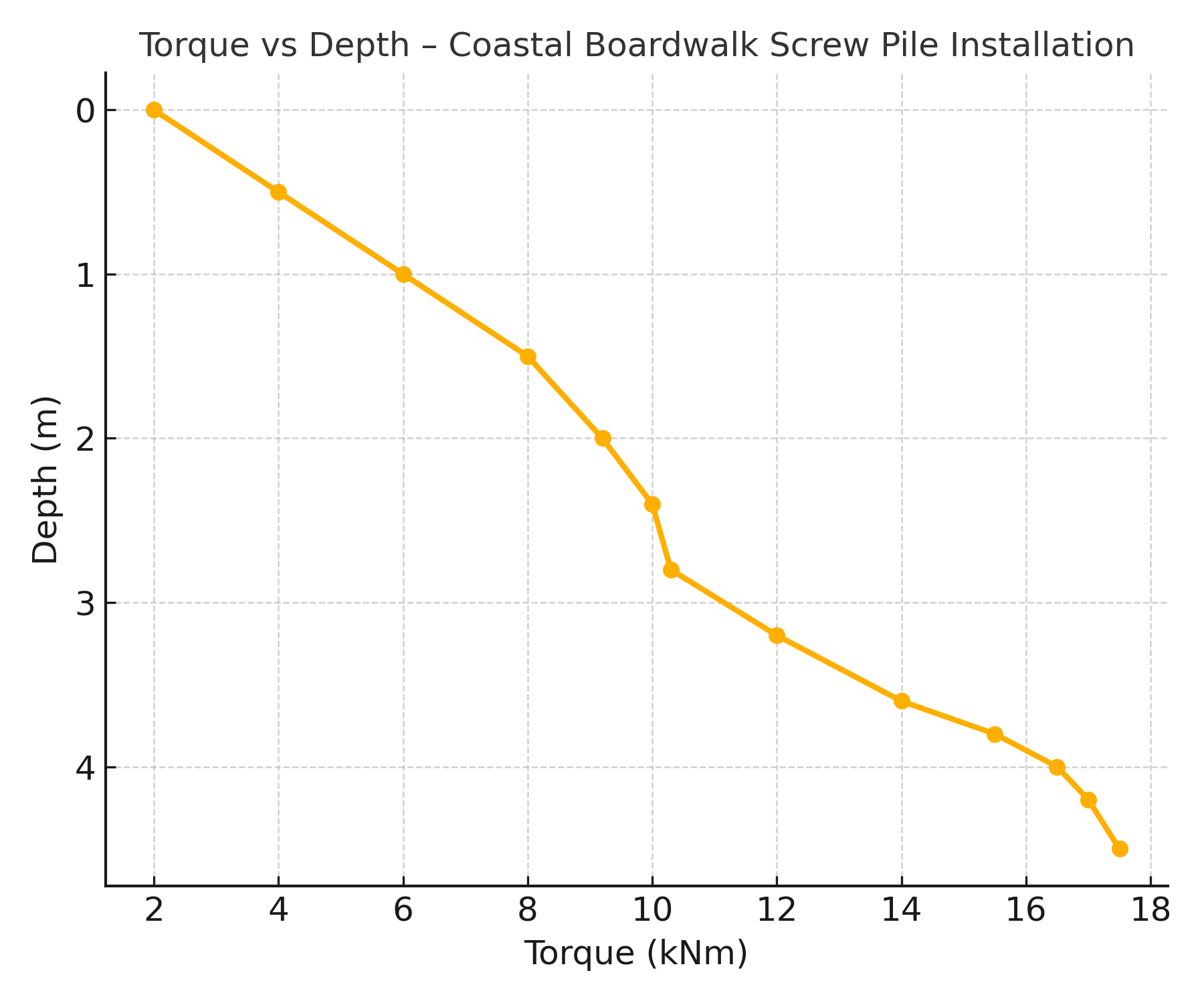
Torque vs Depth Sample (Pile #87)
- Sand Layer (0–2.4 m): Torque steady at ~10 kNm
- Clay Layer (3.8–4.5 m): Torque increase to 17.5 kNm
- Smooth transition zone confirmed via graph trend without capacity dips
Environmental
- CO₂ Savings: ~1.2 tonnes reduction from fewer machine hours
- Public Access Restoration: Boardwalk opened 9 days earlier than scheduled
- Reduced Ground Disturbance: 28% less surface compaction in monitored areas
Implications
- Adaptive Installation Improves Performance: Torque calibration in mixed soil profiles ensures consistent capacity with less rework.
- Coating Systems Are Critical in R4 Environments: Combination of hot-dip galvanising and epoxy outperformed specification during salt spray testing.
- Time Efficiency Multiplies Benefits: Faster completion reduced environmental impact, operational costs, and community disruption.
Rotabond specialises in advanced screw pile solutions for coastal and environmentally sensitive sites. Contact our engineering team to discuss torque-calibrated installation for your next project.
References
- Standards Australia. (2009). AS 2159:2009 – Piling – Design and Installation
- Standards Australia. (2017). AS 1726:2017 – Geotechnical Site Investigations
- NSW Government. (2016). Coastal Management Act 2016
- Hoyt, R. M., & Clemence, S. P. (1989). “Uplift Capacity of Helical Anchors in Soil.” In Proceedings of the 12th International Conference on Soil Mechanics and Foundation Engineering (Rio de Janeiro)
- American Petroleum Institute. API RP 2A‑WSD: Recommended Practice for Planning, Designing, and Constructing Fixed Offshore Platforms (Working Stress Design)